This independent guide explains those mechanics while making clear that Gamdom’s terms exclude people who reside in or are located in the United States.
Start with the US eligibility boundary
Gamdom’s terms state that people residing in the United States or physically located there are excluded. That restriction applies to this topic even when a reader is researching slot rules, comparing game formats, or looking at general educational material. This page is not an invitation to create an account, deposit funds, or play on Gamdom from the United States. A person’s interest in a game does not establish eligibility to use the operator.
The operator’s terms identify Moon Revolution Limitada and describe an offshore licence. That is an attributed statement about the operator, not evidence of authorization in the United States, and a foreign licence does not override the rules that apply where a person lives or is physically present. This publication is independent of the casino brand. Its explanations are informational, not legal or tax advice; readers outside the United States should check applicable local rules and the operator’s current terms.
What a slot game is
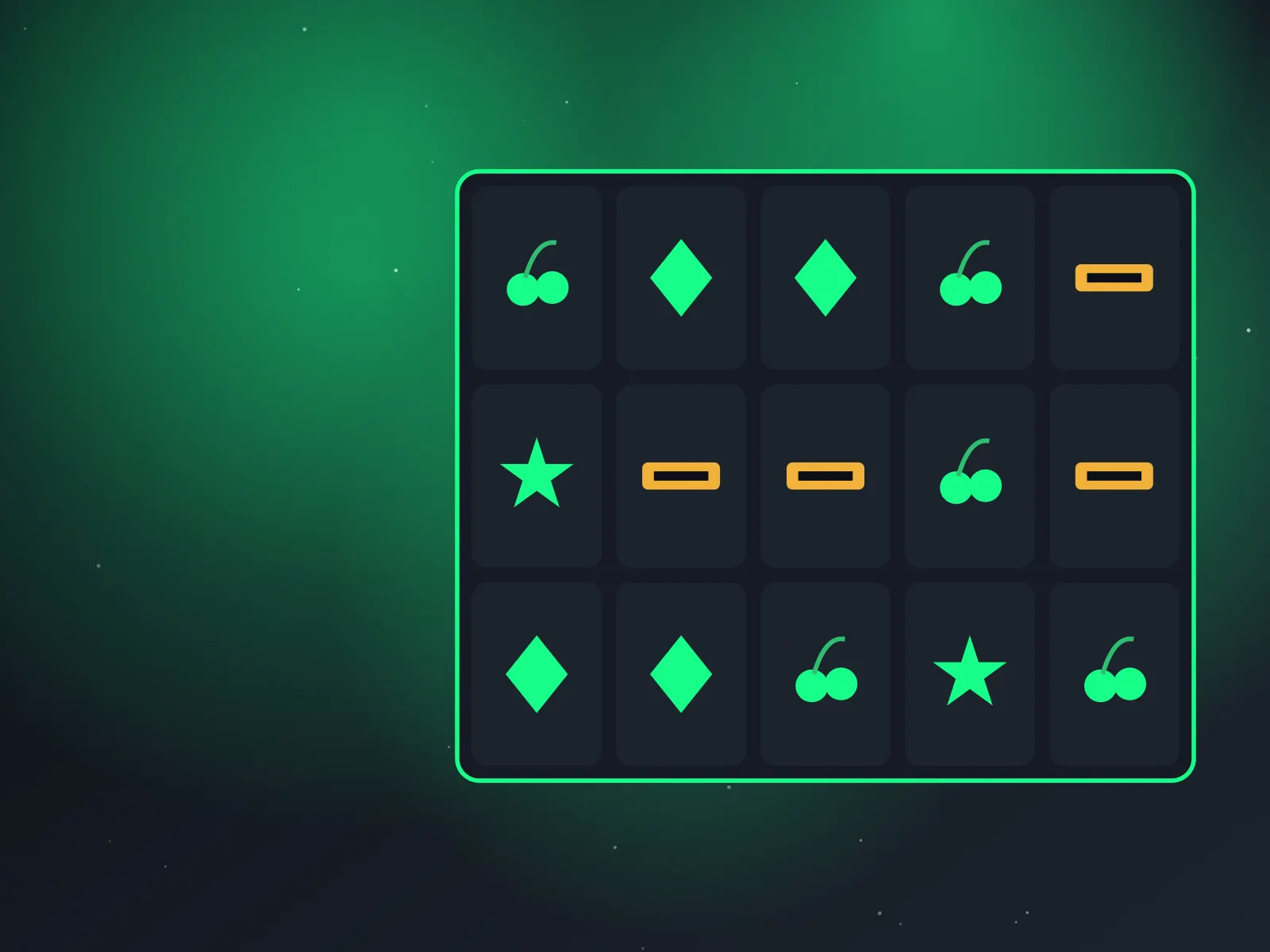
A slot is a game in which a result is generated for each play according to the game’s rules. The familiar format uses reels containing symbols, but modern slots may present symbols on grids, use multiple ways to form a winning combination, or add features that change how a round unfolds. A themed screen can make two games look alike even when their paytables, symbol arrangements, and bonus mechanics differ substantially.
Gamdom’s official help material categorizes slots alongside live casino and table games. These are distinct formats: a slot generally presents a software-generated result, while a live casino game involves a live-dealer format, and table games follow their own rules and decision structures. Knowing which category a game belongs to helps set expectations, but category labels alone do not reveal the specific probability, cost, or rules of an individual title.
Reels, symbols, and winning patterns
In a classic-looking slot, reels display symbols after a play. A paytable explains which combinations may pay and how the game evaluates them. Some games use fixed paylines—defined paths across the reels—while others count adjacent matching symbols in several directions or use a grid-based system. A symbol that appears important in the artwork is not necessarily valuable; the paytable, rather than the theme or animation, is the place to check its function.
Consider two fictional games with the same number of reels. One might award a return only for matching symbols along a set line, while another might count matching symbols from left to right across neighboring reels. Their screens may feel familiar, but the conditions for a winning result are not interchangeable. Wild symbols may substitute for other symbols, and scatter symbols may trigger a feature, yet each title defines these terms differently. Treat feature names as labels, then read the rules for their exact meaning.
Paytables and return-to-player figures
A paytable is the game’s rule reference for symbol values and features. It can explain how a combination is counted, whether a special symbol substitutes for others, what triggers a bonus round, and whether different bet sizes alter available options. Read it before interpreting a game’s visual cues. If a rule or figure is unclear, avoid assuming that a familiar convention from another slot applies to this one.
Some games display a theoretical return-to-player, or RTP, percentage. It describes a long-run mathematical expectation under the game’s stated model; it does not promise that a particular person will receive that percentage back over a session, a day, or any other short period. A displayed figure is not a forecast of a personal result. It is also not a reason to treat a slot as a way to earn income, recover losses, or fund expenses.
Volatility and uneven outcomes
Volatility describes how unevenly a game’s results may be distributed, not whether a particular spin is due to pay. A lower-volatility design may have more frequent, smaller outcomes in its theoretical model, while a higher-volatility design may have less frequent outcomes with greater variation. These are broad descriptions, not guarantees. Individual results can differ sharply from a game’s long-term statistical profile, especially over a small number of plays.
For example, imagine two fictional slots with similar theoretical RTP figures. One could produce modest outcomes more often, while the other could concentrate more of its modeled return into less frequent events. The same headline percentage would not mean the play experience is identical. Volatility information, when available, can help explain the shape of potential variation, but it cannot tell a player what will happen next. No sequence of empty results makes a later payout inevitable.
Randomness and what a spin cannot tell you
A slot’s results should be understood as outcomes generated under that game’s rules, not as a narrative that can be decoded from recent symbols. A run of similar results does not establish that the next result will be different, and a near miss does not prove that a payout is approaching. Animations, sound effects, and dramatic pauses are presentation features; they are not reliable signals about future outcomes.
This matters because people naturally look for patterns in random-looking sequences. For instance, several plays without a particular symbol can feel like evidence that it is “due,” even when the game’s rules provide no such guarantee. A responsible explanation distinguishes the appearance of a pattern from a proven predictive method. There is no dependable strategy for forcing a slot to produce a desired result, and advice that promises to beat a slot through timing or repeated betting should be treated skeptically.
Bonus rounds and special features
A slot may include free-spin rounds, expanding symbols, multipliers, pick-and-reveal screens, or other features. Such mechanics can make a title more complex, but complexity does not itself indicate better value. The rules should explain how a feature is triggered, whether it depends on particular symbols, and how its outcomes are evaluated. A feature’s name or graphics cannot substitute for its written rules.
A bonus round is still part of the game’s overall design, not a separate promise of a favorable result. Some features may be triggered infrequently; others may change the number of ways a result is counted. If a game presents a choice within a feature, the relevant information is the game’s own explanation of that choice. Do not infer that a selection has a predictable advantage unless the rules establish one. Nor should a feature be confused with an operator promotion: game mechanics and promotional terms are separate subjects.
Comparing slots with other game categories
Gamdom’s official help material lists slots, live casino, and table games as casino categories. A slot typically centers on an individual generated result and a paytable. Table games may involve rules about decisions such as whether to draw or stand, while live casino games present a live-dealer format. These are useful distinctions in how the games are structured, not rankings of which category is safer, more predictable, or suitable for a particular person.
The brand also lists in-house Gamdom Originals such as Crash, Dice, Plinko, Mines, HiLo, and Roulette in its official help material. These names refer to formats distinct from conventional reel slots, even if they appear within the same casino environment. For example, a game organized around a rising multiplier or a board of selectable positions does not become a reel slot simply because it is displayed beside slot titles. Classifying the format correctly helps readers understand which rules to examine.
How to evaluate a game’s information
A useful comparison begins with the rules, not with artwork or promotional language. Check the paytable, symbol definitions, stake options, and any information provided about RTP or volatility. Look for an explanation of how a result is counted and how special features begin. If an important detail is unavailable or difficult to interpret, that uncertainty is itself relevant: do not fill the gap with assumptions drawn from another game.
A simple comparison table can keep observations factual: list the game format, how wins are evaluated, which special symbols or rounds exist, and what statistical information is shown. Avoid presenting a single figure as a complete measure of quality. RTP does not describe short-term variation, and volatility does not reveal the chance of a specific next result. A neutral comparison explains what the information does and does not establish rather than declaring a game a winner.
Limits, breaks, and signs to pause
For anyone legally eligible to use a gaming service in their location, it is sensible to decide in advance whether entertainment spending fits within a personal budget and to stop when that limit is reached. A time boundary can also help prevent a session from expanding without notice. These are general harm-reduction ideas, not a method for making gambling profitable, and they do not change Gamdom’s exclusion of US residents and people physically in the United States.
Pause if play begins to interfere with bills, sleep, work, relationships, or other responsibilities, or if a person feels pressure to continue in order to win back losses. Hiding activity, borrowing to gamble, or feeling unable to stop are serious warning signs. Taking a break and seeking appropriate support are more constructive than raising stakes or looking for a supposedly guaranteed strategy. Support options and rules vary by location, so a reader should seek help available in their own jurisdiction.
Accounts and security: information, not an invitation
This guide is not a login form or a route to account access. Because Gamdom excludes people located in or residing in the United States, US readers should not use these explanations to create or access an account, deposit, or play. For a past-account question, distinguish general security concerns from eligibility: a person should not misrepresent their location or attempt to get around the operator’s restrictions.
For account security generally, use a unique password, protect access to the email account associated with a service, and be cautious of messages requesting credentials or payment details. Do not share authentication codes or passwords with someone who contacts you unexpectedly. Gamdom’s official impersonation guidance says the brand has no official mobile app and exists only as a website. That statement is a warning against supposed app downloads, not a recommendation to access the site or an endorsement of third-party software.
Past-account payment or withdrawal questions
A former user may have an administrative question about an existing account, but that is different from permission to continue gambling. Gamdom’s official withdrawal guide describes a Wallet and Withdraw process, checks of currency and destination, fees displayed before confirmation, and a withdrawal history. The guide also distinguishes operator processing from confirmation on a payment network. Those descriptions are operator-provided process information, not a promise about timing or a guarantee that a particular request will succeed.
Anyone making a past-account enquiry should rely on the operator’s current official information and keep records of relevant account activity. Check the displayed currency, destination details, and any disclosed fee before confirming a transaction where eligible to do so. Do not infer that a transaction is complete merely because an operator has processed it; network confirmation may be a separate stage. This is general explanation, not a request for US readers to deposit or withdraw through Gamdom, nor legal or tax advice.
Finding authentic information and avoiding impersonators
Search results and social posts can mix official information with third-party claims. Verify that a message or page is genuinely associated with the operator before relying on it, particularly if it asks for credentials, payment, or a software download. An unsolicited contact claiming to be support deserves caution. Do not assume that a logo, familiar colors, or a brand name proves that a page or account is authentic.
Gamdom’s official FAQ states that support is available around the clock through live chat or an email address identified in that FAQ. This is an attributed description of the operator’s support channels, not a guarantee of response time or outcome. US readers should not interpret support information as permission to open or use an account. A past-account administrative matter and new participation are different questions, and the terms’ US exclusion remains relevant.
A practical way to read a slot page
When reviewing a slot description for educational purposes, separate three kinds of information. First are mechanics: reels or grids, symbol rules, paylines or ways to win, and feature triggers. Second are statistical descriptions such as RTP and volatility, if provided. Third are operator or account matters, including eligibility and terms. Keeping these categories separate prevents a game feature from being mistaken for a financial promise or a jurisdictional permission.
Then ask what remains unknown. A short description may not specify every probability or explain how a feature behaves in each situation; the full game rules may be needed. A displayed RTP may describe a theoretical model without predicting a personal session. A brand’s offshore licence statement does not answer whether access is permitted where a reader lives. These distinctions make a review more useful because they show both the available information and its limits.
Bottom line for US readers
Slots vary in structure, payout conditions, and the way potential returns are distributed. Paytables explain how symbols and features work; RTP and volatility describe different aspects of a game’s theoretical behavior; neither tells a player what the next result will be. Comparing rules carefully is more informative than relying on themes, streaks, or claims of a sure method.
For Gamdom specifically, the central eligibility fact is clear: its terms exclude people residing in or located in the United States. This independent educational page does not provide US access, recommend signup, or encourage deposits. Foreign licensing statements do not establish US authorization, and no explanation of slot mechanics changes the operator’s stated restriction. Readers elsewhere should independently review local requirements and current operator terms before making any decision.
No matching questions found.
Can people in the United States play slots on Gamdom?
Does Gamdom’s offshore licence make it available in the US?
What does RTP mean on a slot?
Does a slot become more likely to pay after a losing streak?
Are Gamdom Originals the same as reel slots?
Does Gamdom have an official mobile app?
Can I use this guide to sign in or open an account?
Where can a past account holder find payment information?
Sources and related reading
Consult the Gamdom website and operator terms. Operator descriptions are attributed claims; an offshore licence statement does not establish authorisation or eligibility in every country.
Product descriptions
An operator category describes a product; it does not establish availability everywhere.
Open sectionProbability and outcomes
Random outcomes and theoretical averages do not predict an individual result.
Open sectionEvidence and questions
Separate a documented claim from an assumption, testimonial or advertising label.
Open sectionAbout Gamdom
External referral. Gamdom excludes US users. →
US information edition. Gamdom excludes US residents and people physically located in the United States.